Three years of Manipur’s expanding ethnic conflict
The violence that erupted in Manipur on 3 May 2023 and has now completed three years as of May 2026, did not produce a simple binary confrontation between Kukis-Zomis and Meiteis.
In the shifting landscape of militancy and ethnic conflict in Manipur, fresh tensions have emerged between Kuki and Naga groups, opening a new front in a state already scarred by three years of violence.





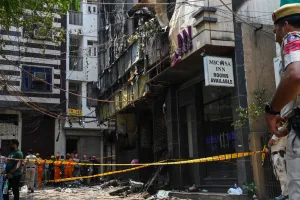
Photo:SNS
In the shifting landscape of militancy and ethnic conflict in Manipur, fresh tensions have emerged between Kuki and Naga groups, opening a new front in a state already scarred by three years of violence. The development has revived memories of the Kuki-Naga conflict of the 1990s. In 1992, the killing of an 18-year-old Kuki National Army (KNA) cadre, Onkhollet Haokip, near Moreh along the India-Myanmar border, triggered a prolonged cycle of violence between Kuki and Naga armed groups.
The conflict, which lasted until 1998, claimed nearly 1,000 Kuki and around 400 Naga lives before gradually subsiding. The latest tensions come against the backdrop of the ongoing Kuki-Meitei ethnic conflict that began on 3 May 2023. The violence has since reshaped social and political relations across the state, leaving communities deeply divided and large areas segregated along ethnic lines. The immediate trigger for the latest Kuki-Naga confrontation appears to have been an incident on 7 May in Ukhrul district.
Advertisement
According to reports, a Tangkhul Naga youth was allegedly assaulted by a group of intoxicated Kuki youths and subsequently hospitalised at the Regional Institute of Medical Sciences in Imphal. The incident drew the attention of both the Chief Minister and Deputy Chief Minister. Rather than tensions easing, the situation escalated. Violence spread to villages in the Litan area, where houses belonging to Tangkhul residents were set on fire. Reports indicate that at least 16 Tangkhul houses were burnt, while one Kuki house was later torched in retaliation.
Advertisement
Civil society organisations soon entered the fray, issuing competing claims and counter-claims, while sporadic exchanges of fire were reported from several Tangkhul and Kuki villages. A more serious development occurred on 13 May when three senior leaders of the Thadou Baptist Association of India were killed in an ambush while travelling from Churachandpur to Kangpokpi. Their convoy was using an alternative route bypassing Imphal, locally known as the German Road or Tiger Road, when gunmen opened fire between Kotlien and Kotzim villages.
Those killed were Dr Rev Vumthang Sithlou, President of the Thadou Baptist Association of India and former General Secretary of the Manipur Baptist Convention; Rev Kaigoulum Lhouvum, Finance Secretary of the Association; and Pastor Paogulen Sithlou. Four others, including two drivers, sustained injuries. Responsibility for the attack remains disputed. Kuki organisations have blamed the Zeliangrong United Front (ZUF) (Kamson faction) and valley-based militant groups, while some Naga voices have alleged involvement of the Kuki Liberation Army, a fringe group. Speaking to The Statesman, Michael Lamzathang Haokip, who has publicly argued that the Thadou community should not be categorised as Kuki, said the location of the ambush raised questions because the area was widely regarded as being under the control of Kuki groups.
He argued that investigators would need to establish who had prior knowledge of the church leaders’ movements. Prior to the ambush, tensions had already escalated along the India-Myanmar border. On 7 May, three Tangkhul Naga villages ~ Wanglee, Namlee and Z Choro ~ reportedly came under armed attack from across the border. Competing accounts have emerged regarding the identities and affiliations of those involved. The crisis has since expanded beyond armed confrontation. Reports of hostage-taking surfaced after members of both communities allegedly detained civilians, including women and children.
Following the intervention of church leaders and civil society groups, several hostages were released. However, conflicting claims regarding the fate of others have continued to fuel mistrust. The consequences are now being felt across large parts of Manipur. Blockades, restrictions on movement and disruptions to the flow of goods have deepened ethnic segregation. While Kukis prevent flow of food and goods into Meitei and Naga areas, the Nagas are preventing the same from entering Kuki areas. Kukis from Kangpokpi cannot travel to Dimapur in Nagaland and points beyond, because they can no longer pass through Naga-dominated Senapati district.
Likewise, Tangkhul Nagas are now bottled up at Ukhrul as they cannot pass through Kuki-held areas along the route to Imphal. The state government is looking at alternatives, including the idea of establishing Ukhrul-to-Imphal and Kangpokpi-to-Dimapur helicopter services. Meanwhile, tensions remain high in the Imphal Valley. Public anger continues over the deaths of two children killed in a bomb attack in Bishnupur district last month. Alongside demands for justice, calls for updating the National Register of Citizens (NRC) have resurfaced ahead of upcoming census operations.
The Union Home Ministry has also announced the formation of a high-level committee, headed by a former Supreme Court judge, to examine demographic changes across the country. The committee is expected to study the causes and consequences of demographic shifts and recommend administrative, legal and policy measures within a year. Manipur Chief Minister Y Khemchand Singh has welcomed the move and assured full cooperation from the state government.
At the height of the Naga-Kuki ethnic war in the early 1990s, this writer had described Manipur as “India’s Bosnia,” where Indian troops, like UN forces there, stood by as communities slaughtered each other, acting only in their own self-defence. The coinage “India’s Bosnia” was even acknowledged by the BBC. Yet, over the years, Manipur has come to resemble more a modern-day Yugoslavia, where the various communities, like the Croats, Serbs, Macedonians, and others have all drawn lines of division that have only hardened over time.
THE WRITER IS A SENIOR JOURNALIST AT THE STATESMAN
Advertisement